
Measuring for a Sleeper Sofa, Small Spaces Included
A sleeper sofa is the one piece you have to measure twice: once as a couch, and once again as a pull-out bed.
Most people get the first measurement right and forget the second. Then comes the moment of truth: the bed is unfolded, the coffee table is suddenly in the way, and there’s almost zero room left to walk around it.
In a small apartment, that open footprint matters just as much as the sofa itself. Before you fall for a sleeper sofa, measure the space it needs when it's closed, when it's fully open, and when you're trying to get it through the front door. A few extra minutes with a tape measure can save you from discovering that your dream sofa has nowhere to sleep.
Start with the room, not the sofa
Measure the room where your sleeper sofa will live. Start with the wall the sofa will be propped against, then measure the available floor space in front of it.
Now look at everything that is fixed: windows, radiators, floor outlets, media consoles, doors, and architectural quirks all count. A sofa might fit neatly against the wall, but if opening it blocks the only walkway through the room, you've solved one problem and created another.
For a small apartment, think beyond the sofa's everyday footprint. You need to know how much room remains when the bed is fully extended. Grab some painter's tape and mark the approximate footprint on the floor. It’s much easier to spot a clearance problem while you're standing over tape than at midnight with an overnight guest waiting for somewhere to sleep.
How to measure a sofa: the three numbers that matter
Most people measure the width and call it done. But width alone barely tells you whether a sofa fits. Three numbers do:
Width: Measure the widest run of wall the sofa can take, then leave a few inches of breathing room on each side. A piece can fit and still make a room feel packed.
Closed depth: How far the sofa shoves itself into the room when it's just being a sofa. Measure from the wall out. This is the number that decides your walkways, where the coffee table can go, and whether the room still flows.
Open depth: Pull the sleeper mechanism out completely and measure from the back of the sofa to the furthest edge of the mattress. You need enough clearance around the bed to get in, get out, and change the sheets without performing furniture gymnastics. As a general rule, aim for at least 24 inches of clear space around the accessible sides of the bed. More is better if your room allows it.
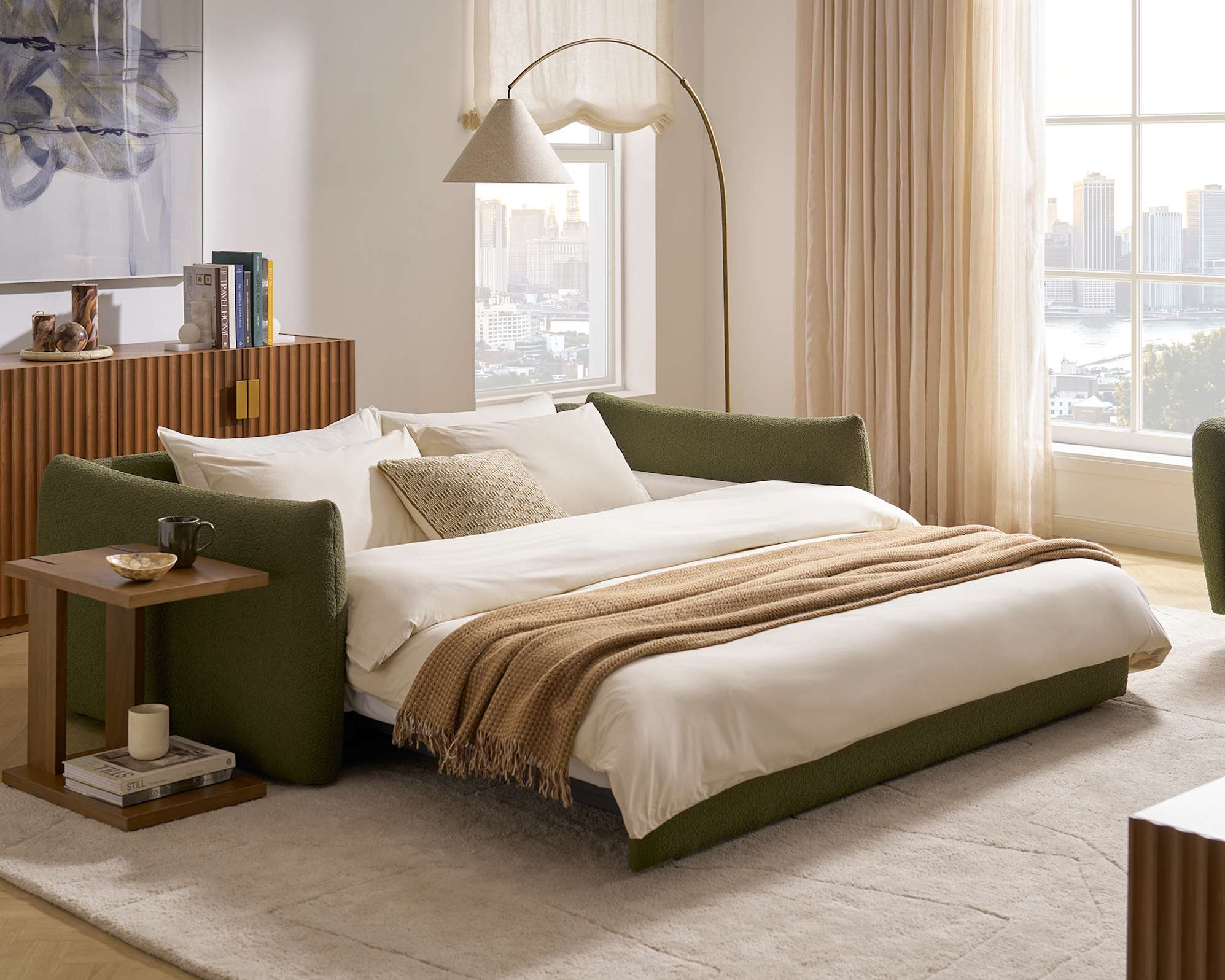
The Agnes Chaise Sectional Sleeper Sofa
Picture credits: @evanysphotography
The Agnes Chaise Sectional Sleeper Sofa
Picture credits: @evanysphotography

The Agnes Sleeper Sofa
Picture credits: @kailanitomkins
The Agnes Sleeper Sofa
Picture credits: @kailanitomkins

Measure the delivery path, not just the room
Finding a sleeper that fits your living room is only half the job. It also needs to make the journey there. This is particularly important in apartments, where narrow hallways, tight staircases, and compact elevators can turn delivery day into an elaborate game of angles.
Measure the entire route from the building entrance to the room where the sofa will live.
Doorways: Measure the width and height of every doorway along the route. Don't just measure the door to the living room. The narrowest opening is the one that matters.
Hallways: Measure the narrowest section of every hallway, including any points where the sofa will need to turn.
Stairs: Check the width of the staircase and the available ceiling clearance, particularly around landings and corners.
Elevators: If you're relying on an elevator, measure both the elevator door opening and the interior dimensions. You'll also need to account for how the sofa will be positioned inside.
Tight turns: A straight hallway might be wide enough, but a sharp corner can still stop a large piece in its tracks. Measure the space around corners and other pinch points.
And don't assume the assembled sofa dimensions tell you everything. Check the manufacturer's packaging and delivery dimensions where available. The sofa that eventually sits beautifully in your apartment may arrive in a box that has considerably less interest in squeezing through your doorway.
Sleeper sofa sizes at a glance
Sleeper sofas are typically named according to the mattress size inside, so you'll often see twin, full, and queen options, similar to standard bed sizes.
One important difference is that sleeper mattresses can be shorter than their conventional counterparts. Depending on the design, many are around 72 to 75 inches long, so taller guests may notice the difference.
Exact dimensions vary by model, so use the figures below as a starting point rather than a substitute for checking the product specifications.
| Sleeper type | Mattress size (W x L) | Typical sofa width | Typical closed depth | Typical open depth |
|---|---|---|---|---|
| Twin / single | 38–39" x 72–75" | 55–70" | 37–40" | 75–85" |
| Full / double | 54" x 72–75" | 70–80" | 38–40" | 80–88" |
| Queen | 60" x 72–74" | 79–90" | 85–90" |
Notice where the dimensions change. Moving from a twin to a queen sleeper generally adds more width than length, because the mattress gets wider while its length remains relatively similar.
And that distinction matters in a small room. If you're short on wall space, a larger sleeper may be the wrong direction to go. If you're short on floor space in front of the sofa, however, moving up or down a sleeper size may not make as dramatic a difference as you'd expect.
A sleeper worth measuring for
A good sleeper sofa should have two jobs and make both look easy. During the day, it needs to function as comfortable seating without swallowing your living room. At night, it needs enough space to become a proper sleeping surface without turning your apartment into an obstacle course.
Get these measurements right, and your sleeper becomes less of a compromise and more of a clever piece of furniture: a sofa when you need somewhere to sit, a bed when someone needs somewhere to sleep, and no frantic furniture shuffling required.
Frequently asked questions about sleeper sofas
What are the standard sizes for sleeper sofas?
Most sleeper sofas come in three sizes, named for the mattress they hold: twin, full, and queen. Twin, sometimes called single, is the most compact and a common pick for small apartments. Queen is the largest common option at 60 inches of sleeping width, though its mattress often runs shorter than a standard bed.
Are most sleeper sofas full or queen size?
For a standard three-seat sleeper sofa, queen is the most common, since it gives the most comfortable sleeping width for two. Both of Castlery's three-seater sofas, the Agnes and the Hamilton, are queens for that reason. Full-size sleepers show up more often on compact models made for small apartments.
What is the average depth of a sleeper sofa?
Closed, most sleeper sofas run about 38 to 40 inches deep, a touch more than a standard sofa to fit the folded mattress and mechanism. The Agnes Sleeper Sofa is 39.4 inches deep as a sofa. Open, plan for around 85 to 90 inches from the wall to the end of an extended queen bed.
